


Most people think cold brew is just a way to hide the flavor of old, stale coffee beans that should have been thrown away weeks ago. It's a common mistake that leads to a drink tasting more like dirt or wood than a premium beverage. You've likely spent money on expensive bags only to end up with a flat, bitter concentrate after a long overnight soak. It feels like a waste of time and resources when the result doesn't live up to the hype. We believe you deserve a better experience from your morning cup. Finding the best coffee beans for cold brew isn't about grabbing whatever is on sale; it's about matching the right origin and roast to the cold extraction process.
In this 2026 guide, you'll learn how to choose beans that produce a naturally sweet, chocolatey, or fruity profile without the harshness. We'll explore why small-batch freshness matters and how different regions, from Kenya to Honduras, impact your final brew. You will gain the knowledge needed to stop guessing and start brewing cafe-quality coffee in your own kitchen.
Key Takeaways
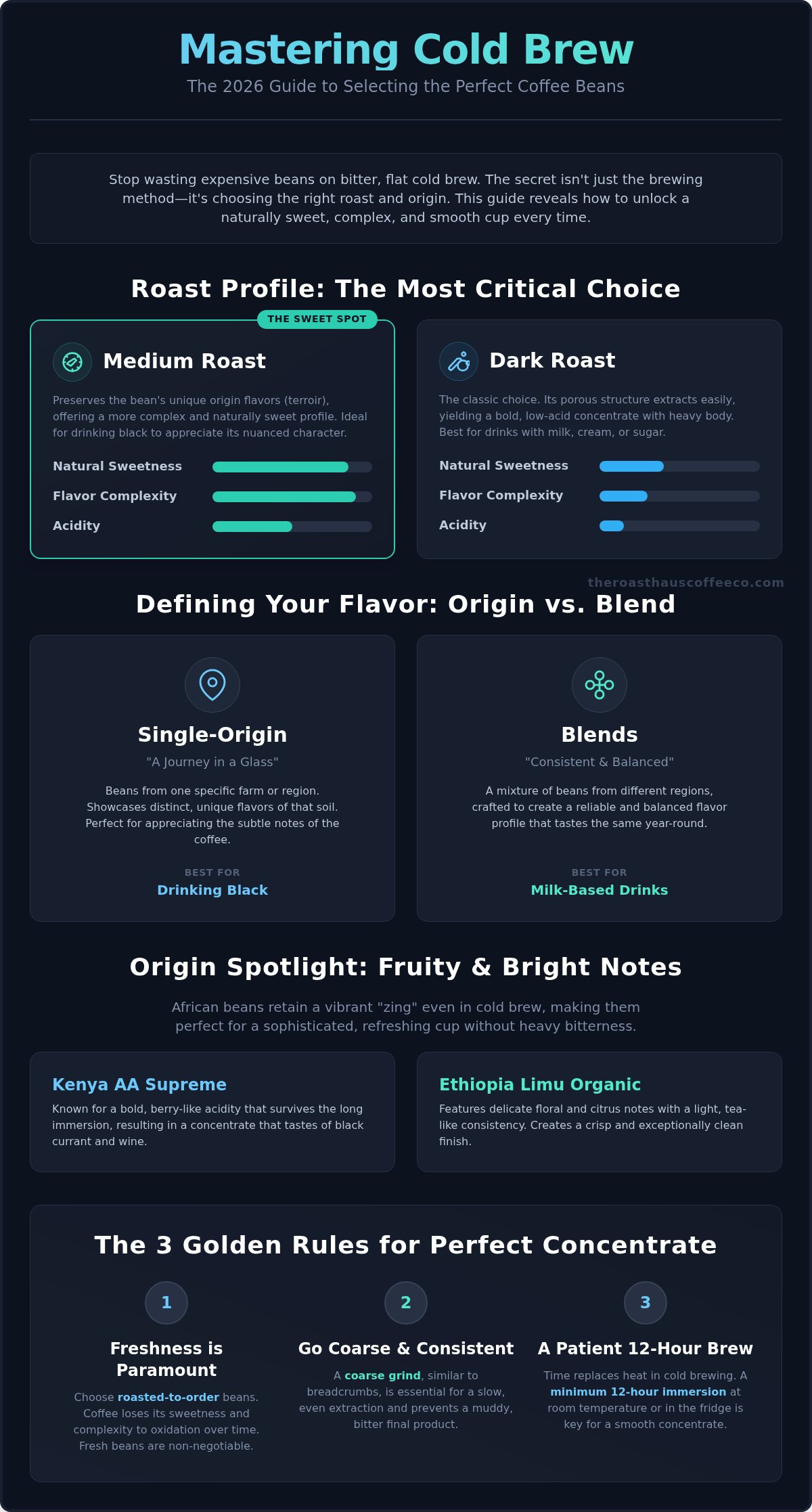
- Learn why medium roasts often outperform dark roasts by providing a cleaner, more complex flavor profile during the slow extraction process.
- Find the best coffee beans for cold brew by choosing roasted-to-order options that don't lose their natural sweetness to oxidation.
- Identify the differences between single-origin beans and blends so you can select the right profile for black coffee or milk-based drinks.
- Master the method for creating a smooth concentrate by using a consistent coarse grind and a patient 12-hour immersion.
Choosing Your Roast: Why the "Best" Cold Brew Beans Aren’t Always Dark
Most beginners reach for the darkest bag on the shelf when they start their first batch. They assume the long immersion time requires a heavy, oily bean to produce any noticeable flavor. This is a common myth that often leads to a bitter, one-dimensional drink. Roast level actually dictates the solubility of the bean during the 12 to 24 hour soak. If you want to understand the basics of roast levels before diving deep into your brew, check out our ultimate beginner guide to choosing coffee beans.
Heat acts as a catalyst in traditional brewing to pull out flavors quickly. Without it, we rely entirely on time. Darker roasts have more porous structures because the heat of the roaster has expanded the bean further, making them easier to extract. However, a medium roast offers a different chemical makeup that thrives in cold water. Understanding what is cold brew coffee helps you see that it's a slow extraction of oils rather than a quick wash of acids. The result is a drink with significantly lower acidity than a standard hot cup.
As a bean roasts longer, the flavor profile moves from bright and floral to nutty and chocolatey. If you pick the best coffee beans for cold brew based solely on old traditions like "French Roast," you might miss out on the complex, fruit-forward notes found in lighter profiles. We've found that a careful, small-batch roast allows the bean's natural character to shine through the cold water without being masked by smoky or burnt notes.
Dark Roast: The Classic Chocolate and Nut Profile
Dark roasts remain the standard for high-strength concentrates. The roasting process physically breaks down the cellulose in the bean, which makes it much easier for cold water to extract the oils and sugars trapped inside. You can expect a heavy body with very low acidity. The flavors lean toward molasses, toasted nuts, and dark cocoa. It's the reliable choice for anyone who adds plenty of cream or sugar to their morning glass, as the bold flavor isn't easily lost.
Medium Roast: The Sweet Spot for Modern Cold Brew
Medium roasts are the "sweet spot" for the modern enthusiast. These beans preserve the terroir, which is the unique taste of the soil and region where the coffee grew. If you enjoy drinking your coffee black, a medium roast is usually the winner. It provides a clean finish and a natural sweetness that dark roasts often lose to carbonization. Finding the best coffee beans for cold brew often means looking for this balance between origin character and smooth extraction. It's a balanced approach that highlights the roaster's skill and the bean's integrity.
Single Origin vs. Blends: Defining Your Cold Brew Flavor
Choosing the right beans often comes down to how you plan to drink your final cup. A blend is a mixture of beans from different regions, designed to create a consistent and balanced flavor profile. These are often the safer choice for milk-based cold brew drinks because the bold, chocolatey notes can cut through the cream. On the other hand, single-origin beans come from one specific farm or region. They offer what enthusiasts call a "journey in a glass," showcasing distinct flavors that are unique to that soil. To get the best results, you must start with high-quality coffee beans. Using inferior beans often results in a "muddy" taste where individual flavor notes are lost.
The chemical profile of your concentrate depends heavily on the bean's origin. Recent scientific research on coffee freshness shows that storage and origin significantly impact the sensory quality of cold brew. This is why we focus on small-batch fulfillment. When you select the best coffee beans for cold brew, you aren't just buying a caffeinated drink; you're selecting a specific flavor experience that has been preserved from the farm to your doorstep.
African Origins for a Fruity, Bright Concentrate
African beans are famous for their high acidity and complex fruit notes. While cold brewing reduces overall acidity, these beans still retain a vibrant "zing" that makes them incredibly refreshing. They are ideal for those who want a sophisticated, clear cup of coffee without any heavy bitterness.
- Kenya AA Supreme: This bean is known for a bold, berry-like acidity. It survives the long immersion process and results in a concentrate that tastes of black currant and wine.
- Ethiopia Limu Organic: If you prefer a tea-like consistency, this is your bean. It features floral and citrus notes that are light and crisp.
Latin American beans are the reliable workhorses of the artisan world. They provide the classic coffee flavors that most people love. If you want a crowd-pleasing batch, these are the best coffee beans for cold brew to keep in your pantry.
- Honduras Morning Splendeur: These beans provide a smooth, caramel-heavy base with a very clean finish. They are perfect for those who want a naturally sweet cup without adding sugar.
- Colombia and Mexico: These origins are prized for their balance. They offer a medium body and predictable notes of nut and milk chocolate.
These origins work exceptionally well in our All Day Sampler, allowing you to test different profiles before committing to a larger bag.
The Science of Freshness: Why Roasted-to-Order Matters
At The Roast Haus Coffee Co., we don't believe in letting coffee sit on a warehouse shelf for months. Our roasted-to-order philosophy is the foundation of every bag we ship from Wyandotte. We roast in small batches and ship within 24 hours because cold water is a gentle, slow extractor. It lacks the heat required to force flavor out of old, stale grounds. Finding the best coffee beans for cold brew requires more than just a specific origin; it requires impeccable timing. The oxidation window is the specific timeframe after roasting when oxygen begins to penetrate the bean and degrade the volatile oils responsible for sweetness. Once these oils vanish, your concentrate will taste like paper or wood regardless of how long you steep it.
There is a common objection that the 12-hour brew time is long enough to hide the taste of old beans. This is entirely false. A long immersion actually amplifies staleness. While hot brewing can sometimes mask defects with high acidity, the cold process leaves nowhere for flat, oxidized flavors to hide. This focus on timing is supported by university research on preserving coffee aroma, which explains how quickly volatile compounds escape once the roasting process is finished. If you want a vibrant cup, you need beans that still hold their aromatic gases.
The Problem with Grocery Store Best-By Dates
Grocery store bags use "Best By" dates to hide a coffee's true age. These beans are often six to twelve months old by the time you reach for them. During those months, the coffee loses its natural CO2, which acts as a protective blanket for the flavor. Mass-produced coffee also suffers from uneven roasting in giant industrial drums. Our small-batch artisan process ensures a consistent, high-quality result for every single bean. You get the full spectrum of flavor from our Honduras Morning Splendeur or Kenya AA Supreme because they haven't spent half a year in a shipping container.
Degassing and Cold Brew: The Timing Secret
Cold brew needs a specific degassing period to reach peak flavor. We suggest using your best coffee beans for cold brew between 3 and 10 days after the roast date. If you brew immediately after roasting, the excess CO2 can create a sharp, almost carbonated bitterness. By day three, the beans have settled into their prime flavor profile. You can easily check this using our bag valves. Squeeze the bag gently and smell the aroma; it should be punchy and distinct. If the scent is faint or smells like stale nuts, the oxidation window has likely closed.
The Small-Batch Artisan Advantage in Oklahoma
Choosing the best coffee beans for cold brew involves more than just selecting a roast level. It's about how those beans are handled from the moment they enter the roaster to the moment they arrive at your door. At The Roast Haus Coffee Co., we operate as a family-owned roastery in Wyandotte, Oklahoma. Since 2014, we've focused on a small-batch artisan process that prioritizes quality over volume. This approach allows us to monitor every roast with a level of detail that industrial roasters simply can't match. When you support an independent business like ours, you aren't just buying coffee. You are investing in a local community and a commitment to craftsmanship that is often lost in mass production.
If you're looking for more information on the local scene, our Oklahoma coffee roasters guide provides deeper context on why Wyandotte is the perfect home for our operation. Small-batch roasting is the ultimate differentiator for cold brew because it ensures the beans aren't subjected to the scorched temperatures used in high-speed commercial facilities. This results in a cleaner, more vibrant concentrate that lacks the "dirt" or "wood" flavors often found in supermarket brands. We believe the person drinking the coffee matters just as much as the person roasting it.
From Wyandotte to Your Door: The Roasting Process
Our husband-and-wife team handles each order personally. We don't roast until your order is placed. This roasted-to-order model is critical for flavor integrity, especially for customers who live outside of Oklahoma. By shipping within 24 hours, we ensure the volatile aromatics stay locked inside the bean. For our neighbors in the Wyandotte area, we offer local pickup. This is the fastest way to get the best coffee beans for cold brew into your kitchen, often within hours of the roast finishing. Freshness is a non-negotiable part of our promise to you.
Artisan Quality Control
Large-scale commercial roasts often have a "burnt" or generic taste because the machines are designed for speed. In our small-scale setup, we rely on roaster's intuition to develop the perfect profile for beans like our Honduras Morning Splendeur. We listen for the cracks and watch for the color changes that signal a roast is at its peak. This sensory-focused method prevents the carbonization that causes bitterness in long-immersion brewing. Modern coffee drinkers value transparency and independent business values. By choosing artisan beans, you help sustain a model that respects the product and the person drinking it. To experience the difference that small-batch quality makes, you can order your fresh roasted beans here and start your next batch today.
How to Brew: The Roast Haus Method for Perfect Concentrate
You have selected the best coffee beans for cold brew and confirmed their roast date. Now, the success of your batch depends on your technique. Cold brewing is a forgiving method, but it is not a careless one. The goal is to create a heavy, smooth concentrate that serves as a base for various drinks. We use a 1:4 ratio, which means one part coffee to four parts water by weight. This ratio produces a robust liquid that holds its character even when you add ice or milk. If you prefer a lighter, ready-to-drink version, you can move toward a 1:8 ratio, but a concentrate offers much more versatility for your week ahead.
The most common mistake is using the wrong grind size. If your coffee tastes "muddy" or contains a lot of sediment, your grind is likely too fine. If it tastes weak and tea-like after a full 16 hours, your grind might be too coarse or your ratio is off. For a deeper look at how to achieve the perfect consistency, read The Roast Haus Coffee Co.'s guide to coffee grinders. A consistent, coarse grind is the secret to a crystal-clear cup.
The 5-Step Cold Brew Process
- Step 1: Start with fresh-roasted whole beans. Never use pre-ground coffee for cold brew. Pre-ground beans lose their volatile aromatics within minutes of being processed.
- Step 2: Grind your beans to the texture of coarse sea salt. This large particle size allows water to flow around the coffee, extracting sugars and oils without pulling out the bitter tannins.
- Step 3: Combine your grounds with filtered water in a glass jar or specialized brewer. We recommend a 1:4 ratio. Ensure all grounds are fully saturated by stirring gently with a wooden spoon.
- Step 4: Steep the mixture for 12 to 16 hours at room temperature. Avoid the fridge during the steeping phase; cold temperatures slow down extraction and can lead to a flat flavor profile.
- Step 5: Filter the concentrate twice. Use a metal mesh filter first to remove the large grounds, then pass it through a paper filter or a fine cloth. This second pass ensures a clean, professional finish.
Storing and Serving Your Concentrate
Once filtered, your concentrate should live in the fridge. It stays fresh and vibrant for up to two weeks when stored in an airtight glass container. You can drink it straight over ice, but the real magic is in the versatility. Dilute it with equal parts hot water for a low-acid hot coffee, or use it as a base for milk-heavy lattes. It even works as a powerful ingredient in coffee cocktails. Because The Roast Haus Coffee Co.'s beans are roasted-to-order, the natural sweetness remains present throughout the entire two-week window. Ready to brew? Shop The Roast Haus Coffee Co.'s Roasted-to-Order beans now and taste the difference that artisan quality makes.
Elevate Your Morning with Small-Batch Freshness
You now have the knowledge to move beyond bitter, flat coffee and create a smooth concentrate that rivals any local cafe. Achieving this result starts with selecting the best coffee beans for cold brew and respecting the science of freshness. Whether you prefer the berry-like notes of our Kenya AA Supreme or the caramel sweetness of Honduras Morning Splendeur, the roast date is your most important metric. Stale beans simply can't deliver the vibrant, naturally sweet profile that a 12-hour immersion demands. You deserve a better experience from your daily cup.
At The Roast Haus Coffee Co., we take pride in being a family-owned artisan roastery in Wyandotte, Oklahoma. We roast in small batches to maintain strict quality control for every bag. By shipping within 24 hours of roasting, we ensure those volatile aromatics arrive at your door at their absolute peak. It's time to stop settling for grocery store coffee that was roasted months ago. Take the next step in your coffee journey and experience the difference that dedicated craftsmanship makes. Order Fresh Roasted-to-Order Coffee Beans from The Roast Haus today and start brewing a cup you actually enjoy.
Frequently Asked Questions
Can I use regular coffee beans for cold brew?
Yes, you can use any variety of coffee bean, but the results depend heavily on freshness and quality. Regular grocery store beans are often months old and lack the volatile oils needed for a smooth extraction. Using the best coffee beans for cold brew from an artisan roaster ensures your concentrate doesn't taste like wood or dirt. Always choose whole beans and grind them yourself to preserve the natural sweetness and aromatic complexity.
What is the best roast level for cold brew: light, medium, or dark?
Medium to dark roasts are generally the most successful for this immersion method. Dark roasts provide the traditional chocolate and nut profile many people enjoy with milk. However, medium roasts preserve the unique characteristics of the origin and offer a cleaner, sweeter finish when drank black. We recommend trying a medium roast like our Honduras Morning Splendeur to experience a balanced, caramel-heavy profile without the smoky bitterness of an over-roasted industrial bean.
Should I use single-origin beans or a blend for cold brew?
Your choice depends on how you plan to serve the final drink. Blends are crafted for balance and consistency, making them the reliable choice for milk-based lattes or large batches. Single-origin beans offer a more distinct, adventurous flavor profile. If you want a bright, berry-like concentrate, a single-origin like Kenya AA Supreme is excellent. Both options work well as long as the beans are roasted in small batches to maintain their flavor integrity.
How coarse should I grind my beans for cold brew?
You should aim for a texture similar to coarse sea salt or peppercorns. A fine grind will lead to over-extraction and a muddy, bitter cup that is difficult to filter. A coarse grind allows the water to slowly extract the desired oils and sugars over several hours. This consistency is vital for a crystal-clear concentrate. Using a quality burr grinder will help you maintain the uniform particle size needed for a professional, artisan result.
How long should I steep cold brew for the best flavor?
Most batches reach their peak flavor between 12 and 16 hours at room temperature. If you steep for less than 12 hours, the coffee may taste weak or sour. Steeping beyond 20 hours often pulls out unpleasant tannins and woody notes that ruin the smooth profile. We've found that a 14-hour steep provides the perfect balance of strength and sweetness. Always filter the grounds immediately once your timer goes off to stop the extraction process.
Why does my cold brew taste bitter instead of smooth?
Bitterness usually stems from over-extraction or using beans that are past their prime. If your grind is too fine, the water extracts harsh compounds too quickly. Alternatively, stale beans from a mass-producer often have a "burnt" taste that immersion only amplifies. Using the best coffee beans for cold brew that were roasted within the last few days eliminates this issue. Proper filtration also helps by removing fine particulates that would otherwise continue to extract in the fridge.
For those who want to guarantee a smooth result every time, you can explore E-commerce Coffee Sales and Subscriptions options and select blends that are specifically crafted for a mellow, balanced flavor profile.
Can I use decaf beans for cold brew?
You can definitely use decaf beans for a caffeine-free concentrate. We recommend our Decaf Swiss Water Process beans because they maintain their flavor integrity without the use of harsh chemicals. The cold brew process highlights the natural sweetness of these beans, making them almost indistinguishable from regular coffee. It's a great way to enjoy a rich, chocolatey glass of coffee in the evening without affecting your sleep. The standard 1:4 ratio remains the same for decaf.
How long do roasted coffee beans stay fresh for cold brew?
Whole beans stay fresh for about three to four weeks if stored in an airtight container away from light. For cold brew, the "sweet spot" is between 3 and 10 days after the roast date. This window allows the beans to degas properly while retaining the aromatic oils that cold water needs. At The Roast Haus, we ship within 24 hours of roasting so you receive your order exactly when the beans are entering their prime.

