


You are likely wasting half the potential of your artisan beans before the water even touches the grounds. It is a frustrating reality for many home brewers who invest in high quality, roast-to-order coffee only to end up with a mug that tastes either unpleasantly bitter or disappointingly watery. The culprit is rarely the bean itself. Instead, the problem usually lies in an inconsistent coffee to water ratio. When you rely on vague measurements like heaping tablespoons or splashes of water, you miss the precise mathematical partnership required to unlock the vibrant, complex notes of a small-batch roast.
We understand the frustration of watching a bag of Ethiopia Limu Organic disappear into mediocre batches. You want a repeatable, professional result without needing a degree in chemistry. This guide will teach you the essential math behind the mug, moving you away from confusing kitchen spoons and toward a simple, weight-based formula. We will break down exactly how to calculate your brew for any device, ensuring you get the most out of every gram of fresh coffee. From understanding the golden ratio to adjusting for your specific taste, you are about to gain the confidence to brew like a pro every single morning.
Key Takeaways
- Learn why the 1:16 coffee to water ratio is the ideal starting point for a balanced, professional-grade cup at home.
- Discover how a tighter 1:15 ratio and coarse grind bring out the rich body of immersion-brewed coffee.
- Adjust your ratio for high-altitude beans like Kenya AA Supreme to highlight delicate citrus and berry notes.
- See how beans roasted and shipped within 24 hours produce a more aggressive bloom for better extraction.
- Transition from vague measurements to a repeatable, weight-based formula to stop wasting expensive artisan beans.
The Fundamentals of Coffee Ratios: The "Golden Rules" for Home Brewing
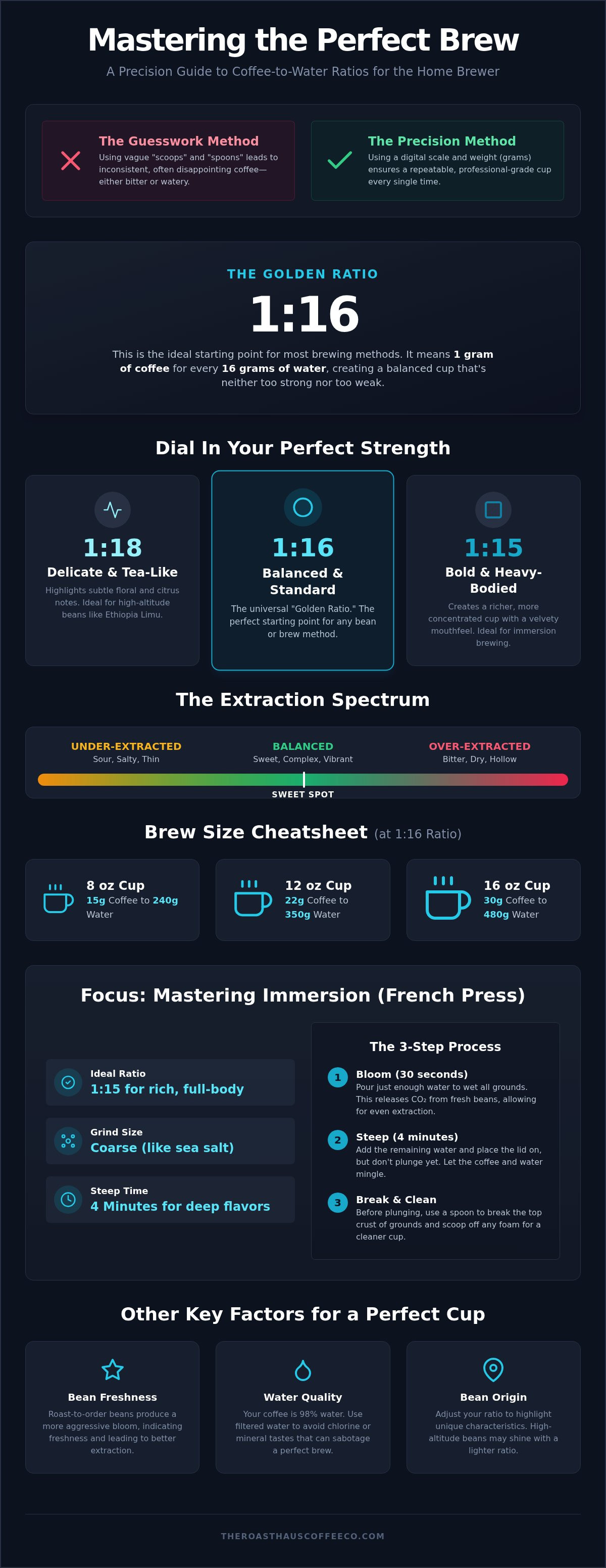
The coffee to water ratio is the relationship between dry grounds and the water used to brew. It is one of the most critical key variables in coffee preparation. Without a consistent ratio, you cannot expect a consistent cup. We recommend a 1:16 ratio as the starting point for most home brewers. This means using 1 gram of coffee for every 16 grams of water. This balance ensures you extract enough sweetness and acidity without overwhelming the palate with bitterness or leaving the cup thin and weak.
Many people rely on tablespoons, but volume is deceptive. Coffee beans vary in size and density depending on the roast and origin. A tablespoon of our dark-roasted Honduras Morning Splendeur weighs less than a tablespoon of the dense, high-altitude Kenya AA Supreme. Use a digital scale. It is the only way to ensure your artisan beans aren't wasted on a bad batch. Remember the 98% rule too. Your coffee is mostly water. If your tap water tastes like chlorine or minerals, it will sabotage your brew. Use filtered water to let the bean's natural profile shine.
Understanding Extraction and Strength
Extraction is the process of water dissolving coffee solids into liquid gold. If you use too much water, you over-extract, leading to a dry, bitter finish. Too little water results in under-extraction, which tastes sour or salty. Strength refers to the concentration of those dissolved solids, while extraction yield is about how much of the bean you actually pulled out. A balanced extraction is the sweet spot between sour and bitter.
The Simple Ratio Chart
Starting with a 1:16 coffee to water ratio provides a reliable baseline. You can adjust this based on your personal preference for body and intensity.
- 8 oz Cup: 15g coffee to 240g water
- 12 oz Cup: 22g coffee to 350g water
- 16 oz Cup: 30g coffee to 480g water
If you prefer a bolder, heavier mouthfeel, tighten the ratio to 1:15. For a more delicate and tea-like experience that highlights floral notes, move to 1:18. To learn more about selecting the right beans for these ratios, check out our guide on Coffee Beans: The Ultimate Beginner’s Guide.
Mastering Immersion: The Ideal Ratio for French Press
Immersion brewing is a unique beast. Unlike pour-over methods where water passes through the grounds, immersion keeps the coffee and water together for the entire duration. This requires a slightly tighter coffee to water ratio of 1:15. Using this ratio ensures the final cup has the heavy, velvety body that French Press lovers crave without sacrificing clarity. As the National Coffee Association points out, the right balance between water and grounds is essential for a successful brew.
Consistency is the hallmark of a great craftsman. Follow these three steps to dial in your immersion brew:
- Step 1: Coarsely grind your beans to the texture of sea salt. If the grind is too fine, the water will over-extract and create a bitter, muddy mess.
- Step 2: Weigh your water to exactly 15 times the weight of your coffee. For a standard 17-ounce press, use 30 grams of coffee and 450 grams of water.
- Step 3: Set a timer for a 4-minute steep. This specific timing allows the water to pull out the deep chocolate and toasted nut notes found in premium small-batch roasts.
The French Press Bloom
Because we flame-roast and ship our beans within 24 hours, they arrive at your door full of carbon dioxide. This gas needs to escape to allow water to penetrate the grounds. Start your brew by pouring just enough water to wet the grounds and let it sit for 30 seconds. This is the bloom. Give it a gentle stir with a wooden spoon to ensure every particle is saturated. After the 4-minute steep, use the "Break and Clean" technique. Use two spoons to scoop off the floating grounds and foam from the surface before plunging. This results in a cleaner, sediment-free finish that lets the flavor profile shine.
Best Roasts for Immersion
Our Honduras Morning Splendeur is the perfect candidate for the French Press. Its flavor profile of cocoa and brown sugar is enhanced by the immersion process. Because a French Press uses a metal mesh filter rather than paper, it preserves the natural oils of the bean. This creates a heavier mouthfeel and a more robust sensory experience. To ensure your grind is consistent enough for this method, you should explore The Ultimate Guide to Coffee Grinders. If you want to experience how a precise coffee to water ratio transforms your morning, consider starting with our Honduras Morning Splendeur for your next brew.
Pour-Over vs. Automatic Drip: Adjusting Your Ratio for Clarity
Clarity of flavor is the primary goal when using paper filters. These filters trap sediment and natural oils, allowing the subtle, wine-like acidity of the bean to take center stage. For manual pour-overs, we recommend a coffee to water ratio of 1:16 or 1:17. This leaner ratio prevents the grounds from over-extracting, which can happen if the water sits too long in the filter. Manual brewing gives you the advantage of controlling water flow. This is vital for unlocking the delicate citrus and floral notes in high-altitude beans.
Automatic drip machines often struggle with temperature consistency. Most home brewers don't reach the ideal 200 degrees Fahrenheit. To fix the "weak" cup common with these machines, try the drip machine hack: tighten your ratio to 1:15. Adding more coffee mass compensates for the lower water temperature, ensuring you still get a full-bodied result. Use the table below to compare how these methods differ in your daily routine.
| Method | Difficulty | Time | Ratio | Best Roast |
|---|---|---|---|---|
| Pour-over | Moderate | 3-4 mins | 1:16 - 1:17 | Ethiopia Limu Organic |
| Auto Drip | Easy | 5-8 mins | 1:15 | Honduras Morning Splendeur |
The Art of the Pour-Over Ratio
Our Ethiopia Limu Organic thrives at a 1:17 ratio. This specific balance highlights tea-like floral notes and a crisp finish. When brewing, use a slow, circular pour to keep the grounds saturated. Avoid pouring directly against the paper wall. This causes water to bypass the coffee, leading to a thin brew. Watch your "draw-down" time. If the water takes longer than four minutes to pass through, your grind is too fine. If it finishes in under three minutes, grind finer to slow the water down and improve extraction.
Optimizing Your Daily Drip
Many people "sneak a cup" while the machine is still brewing. Don't do this. The first half of the pot contains the most concentrated coffee solids, while the second half is mostly water. Pulling the carafe early ruins the extraction balance of the whole pot. To find the "sweet spot" for your specific machine, use our All Day Sampler. It allows you to test different beans at various ratios without committing to a full bag. For more detailed instructions on perfecting your technique, read our guide on How to Make Coffee: The Ultimate Guide. Finding the right coffee to water ratio for your machine will finally make your home brew taste like it came from a professional shop.
Origin-Specific Ratios: Dialing in Kenya AA and Ethiopia Limu
Density and altitude are not just geographic facts. They dictate how you should calculate your coffee to water ratio. High-altitude beans, like our Kenya AA Supreme, grow slower and become much denser than beans grown at lower elevations. This density means they are less soluble than softer beans. You need more heat and a specific ratio to extract their full potential. For African origins like Ethiopia Limu Organic, we recommend using 205°F water and a 1:17 ratio. This leaner balance preserves the delicate citrus and berry notes that make these beans famous.
Latin American profiles offer a different experience. Our Honduras Morning Splendeur is a balanced, versatile bean. It performs well across various ratios, whether you want a bold 1:15 or a standard 1:16. It is the most adaptable choice for those who like to experiment. If you are brewing our Decaf Swiss Water Process, don't settle for a weak cup. Many people think decaf lacks depth, but that is often due to poor brewing. Use a 1:15 ratio to ensure you get full flavor and a satisfying body without any of the bitterness often associated with caffeine removal.
Kenya AA Supreme: The Roaster’s Choice
If you are still learning how to dial in your brew, the All Day Sampler is your best tool. It provides a variety of origins to test against your scale. We suggest keeping a simple brew log in a notebook or on your phone. Record the bean, the water temperature, and the coffee to water ratio you used for every batch. Note the results. Did it taste sour? Use more water next time. Was it bitter? Tighten the ratio. Your palate is the ultimate judge. While the math provides a map, your personal taste is the destination. Trust your senses over a rigid rulebook. You can explore these different profiles and find your favorite by trying our All Day Sampler today.
The Freshness Factor: How Roasted-to-Order Beans Change Your Brew
At The Roast Haus Coffee Co., we believe freshness is a physical state, not just a marketing term. We flame-roast our beans in small batches and ship them within 24 hours of roasting from Wyandotte, Oklahoma. This speed ensures you receive the coffee when it is at its peak chemical potential. Most grocery store coffee sits on a shelf for months, losing its volatile aromatics long before you open the bag. When you use beans this fresh, the physics of your brew change. You will notice a much more aggressive bloom compared to older, stale beans.
Ultra-fresh coffee contains a high concentration of carbon dioxide trapped during the roasting process. In the first 72 hours, the beans degas rapidly. When hot water hits the grounds, this gas escapes, creating a thick, bubbling foam. This process is essential for flavor, but it physically displaces water. To maintain your desired coffee to water ratio, you must manage this bloom carefully. If you don't allow the gas to escape before the main pour, the CO2 acts as a barrier. It prevents water from fully penetrating the grounds, leading to uneven extraction. Always start with a 30-second bloom using twice the weight of the coffee in water. This step ensures your math stays accurate and your extraction remains balanced.
Proper storage is the final piece of the puzzle. Don't put your coffee in the freezer. Moisture is the enemy of quality. The freezer creates condensation every time you open the bag, which destroys the bean's cell structure and ruins the oils. Store your beans in an opaque, airtight container at room temperature. This simple habit preserves the integrity of the beans and ensures your coffee to water ratio produces the same vibrant results every morning.
The Small-Batch Difference
Artisan roasting means we treat every bean with individual care. We monitor the heat and timing of every batch to ensure the roast profile is perfect. This local Oklahoma roasting beats grocery store "shelf-stable" coffee every time because the oils are still intact when they reach your kitchen. This level of quality is vital for technical brewing methods. You can learn more about high-pressure extraction in our guide, What Is Espresso? A Beginner’s Guide.
Join the Haus: Subscriptions and Freshness
Freshness is the secret ingredient you cannot buy in a store. A subscription ensures you never run out of beans that were roasted just hours ago. We take pride in our Wyandotte roots and our ability to deliver artisan quality directly to your door. Our fulfillment model is designed to get the product to you as quickly as possible. You can start your fresh coffee journey with a The Roast Haus Coffee Co. Subscription and experience the difference that roast-to-order fulfillment makes in your daily cup.
Elevate Your Morning Ritual with Precision Brewing
Mastering the coffee to water ratio is the most direct path to a professional-grade cup in your own kitchen. By moving away from vague measurements and embracing a digital scale, you respect the integrity of the beans and the craftsmanship behind the roast. Whether you are dialing in the wine-like acidity of our Kenya AA Supreme or seeking a bold, chocolatey French Press, these simple formulas provide a repeatable foundation for excellence every morning.
At The Roast Haus Coffee Co., we believe your coffee should be as fresh as possible. Since 2014, our family-owned roastery in Wyandotte, Oklahoma, has focused on small-batch production. We flame-roast and ship every order within 24 hours of roasting to ensure you experience the full vibrancy of the bean. Don't settle for stale, grocery store coffee that has lost its soul on a shelf. Take control of your extraction and taste the difference that roast-to-order quality makes. Browse our roasted-to-order coffee collections today. You have the tools and the math; now all you need are the beans to match.
Frequently Asked Questions
How much coffee should I use for one 8oz cup?
For a standard 8oz cup, you should use 15 grams of dry coffee grounds. This measurement is based on the 1:16 golden ratio. Since 8 ounces of water weighs approximately 236 grams, dividing that total by 16 gives you roughly 15 grams of coffee. Using a digital scale ensures you get this exact amount every time. Relying on scoops or spoons is less accurate because bean density changes between different roasts and origins.
What is the best coffee-to-water ratio for a standard drip coffee maker?
The best ratio for a standard home drip machine is 1:15. Most residential brewers don't reach the professional extraction temperatures of 200 degrees Fahrenheit. By using a slightly higher concentration of coffee, you compensate for the lower heat. This ensures your morning pot has a full body and rich flavor rather than tasting thin or watery. It is a simple adjustment that makes a significant difference in your daily brew quality.
Does the coffee to water ratio change for light roast vs dark roast?
Roast level significantly impacts how you should calculate your brew. Light roasts are denser and require more effort to extract flavor, so a 1:17 ratio with hotter water is often best. Dark roasts are more porous and extract very quickly. To avoid a bitter or ashy taste with dark beans, use a 1:15 ratio. This tighter balance limits the amount of water passing through the grounds, keeping the flavors focused on sweetness and oils.
Is it better to measure coffee by weight or by tablespoons?
Weight is far superior to volume for brewing accuracy. A digital scale measures the actual mass of the coffee, while a tablespoon only measures the space it occupies. Because our beans are roasted in small batches, their size and weight vary by origin. A scoop of our Kenya AA Supreme will weigh more than a scoop of a darker roast. Measuring by grams is the only way to achieve a consistent, professional result every morning.
How does the water temperature affect my coffee ratio?
Water temperature serves as the engine for extraction. If your water is too cool, it cannot pull the necessary oils and sugars from the beans, leading to a sour taste. If it is too hot, it pulls out bitter compounds. While the coffee to water ratio determines the potential strength, the temperature determines how much of that flavor is actually released. We recommend brewing between 195 and 205 degrees Fahrenheit for most artisan roasts.
Why does my coffee taste bitter even when I use the correct ratio?
Bitterness is a classic sign of over-extraction. Even if your ratio is perfect, a grind that is too fine will trap water for too long, pulling out unpleasant tannins. You might also be using water that is too hot. Try coarsening your grind slightly or reducing your brew time. If you use a French Press, make sure you plunge and pour immediately at the four-minute mark to stop the extraction process from continuing in the carafe.
What is the "bloom" and how much water should I use for it?
The bloom is the bubbling reaction that happens when hot water hits fresh, roasted-to-order grounds. It is the sound and sight of carbon dioxide escaping the bean. You should use double the weight of your coffee for the bloom water. If you are brewing with 30 grams of coffee, pour 60 grams of water and wait 30 seconds. This allows the gas to clear so the remaining water can extract the flavor profile evenly and efficiently.
Does the grind size affect which coffee to water ratio I should use?
Grind size and the coffee to water ratio are two sides of the same coin. A fine grind increases surface area, allowing you to use a leaner ratio like 1:17 because extraction happens quickly. Coarser grinds have less surface area and extract more slowly, so they require a tighter 1:15 ratio to reach the same strength. Matching your grind to your ratio is the secret to unlocking the specific tasting notes of high-altitude, single-origin beans.

