


You don't need a thousand-dollar espresso machine or a professional barista certification to stop drinking bitter, watery coffee in your own kitchen. Many coffee lovers believe that high-end gear is the only way to achieve a professional result, but the truth is much simpler. Cafe quality isn't about the price tag on your brewer. It's the chemical outcome of using beans at their peak and mastering a few specific extraction variables. If you've ever felt frustrated by inconsistent flavor or confused by which equipment actually matters, you are not alone.
We're here to show you exactly how to make cafe quality coffee at home by using the same logic we apply at the roastery. You'll learn how to move past the guesswork and build a reliable morning routine that brings out the best in beans like our Kenya AA Supreme or Ethiopia Limu Organic. This guide explains the "Golden Ratio" for perfect strength and why the Specialty Coffee Association recommends a precise water temperature between 196°F and 205°F. We will break down the essential techniques to transform your kitchen into a high-end coffee bar without unnecessary expense or filler.
Key Takeaways
- Prioritize roast dates over expensive equipment to ensure your coffee has the necessary balance of sweetness, acidity, and clarity.
- Learn to identify the three stages of flavor extraction so you can prevent bitter plant fibers from ruining your cup.
- Identify whether you prefer body or clarity to choose the home brewing method that best fits your personal taste profile.
- Master the exact 1:16 "Golden Ratio" used by professionals to learn how to make cafe quality coffee at home with total consistency.
- Understand how a roasted-to-order fulfillment model ensures your beans are at their peak degas window when they reach your kitchen.
The Foundation of Cafe Quality: Why Freshness Trumps Equipment
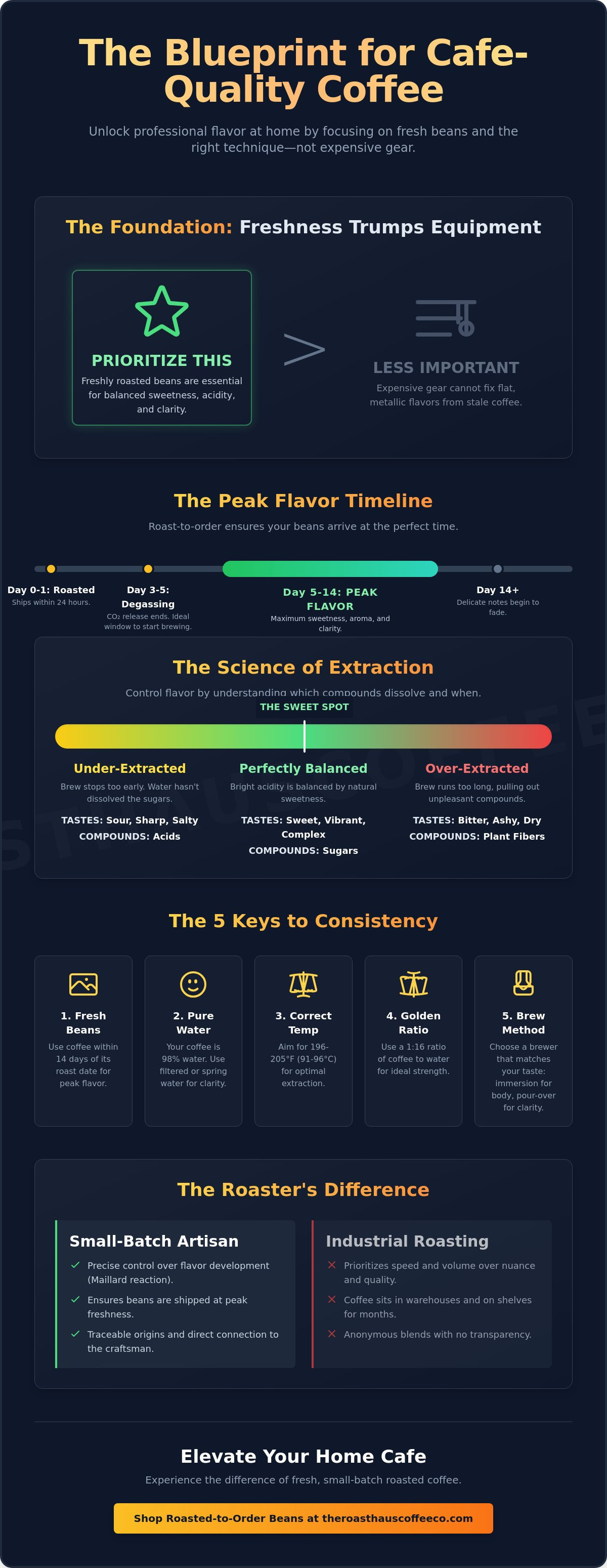
To understand how to make cafe quality coffee at home, you have to look past the shiny equipment on your counter. Professional baristas define cafe quality through three specific sensory markers: sweetness, acidity, and clarity. Achieving this balance is impossible if your coffee beans are stale. Most coffee sold in grocery stores is stale on arrival because it has sat in warehouses and on shelves for months. By the time it reaches your kitchen, the volatile oils that provide flavor have oxidized. This leaves you with a cup that tastes flat or metallic, no matter how much you spent on your brewer.
The secret to a high-end experience is the roast date. We follow a roast-to-order philosophy where beans ship within 24 hours of leaving the drum. This ensures you receive the product during its peak aromatic window. While coffee doesn't spoil like milk, its complex flavors peak within the first 14 days after roasting. After this point, the delicate floral and fruity notes begin to fade. If you want to master how to make cafe quality coffee at home, you must prioritize this timeline.
The Science of Degassing and Flavor Development
When coffee is roasted, carbon dioxide (CO2) builds up inside the bean. This gas is a natural byproduct of the chemical changes during the roast. Immediately after roasting, the bean begins to release this gas in a process called degassing. If you brew coffee the moment it comes out of the roaster, the gas escapes so quickly that it creates a bubbly mess, often leading to uneven flavor. We recommend waiting 3 to 5 days after a small-batch roast before you start brewing. During the brewing process, trapped carbon dioxide acts as a physical barrier that prevents water from fully penetrating the coffee grounds for extraction. Allowing this gas to dissipate naturally results in a cleaner, more vibrant cup.
Small-Batch vs. Industrial Roasting
Industrial roasters process thousands of pounds at a time, often prioritizing speed over nuance. In contrast, artisan roasters use small-batch techniques to carefully control the Maillard reaction. This is the chemical interaction between amino acids and reducing sugars that creates the specific flavor notes in your cup. Whether it's the bright citrus acidity of our Kenya AA Supreme or the floral clarity of Ethiopia Limu Organic, small-batch roasting allows for precise quality control. Supporting independent, family-owned roasters means you get transparency. You aren't buying an anonymous supermarket blend. You're buying a specific agricultural product with a traceable origin and a dedicated craftsman behind the roast who genuinely wants you to have the best experience possible.
Understanding Extraction: The Chemistry Behind the Perfect Cup
Extraction is simply the process of dissolving coffee solids into water. It sounds technical, but it's the most important concept to master if you want to know how to make cafe quality coffee at home. Think of it as a race where different compounds dissolve at different speeds. Acids are the fastest to leave the bean. Sugars follow next. Bitter plant fibers are the slowest to dissolve. If you understand this sequence, you can control the flavor of every cup you brew.
Your goal is to hit the equilibrium point we call the "Sweet Spot." This is where the bright acidity of the bean is perfectly balanced by its natural sugars, but the brew is stopped before the heavy bitterness takes over. If your coffee tastes sharp or sour, it's under-extracted. This means the water didn't have enough time or heat to pull out the sugars. If the coffee leaves a dry, ashy, or unpleasantly bitter feeling on your tongue, it's over-extracted. You can study the science of brewing to see how molecular weights and water temperature influence these chemical reactions. Troubleshooting becomes easy once you know these signs.
Water Quality: The Ingredient You're Ignoring
You can't ignore the fact that 98% of your coffee is water. If your tap water has a high mineral count or smells like chlorine, your coffee will suffer regardless of your technique. Minerals like magnesium and calcium are actually helpful because they help "grab" flavor compounds during extraction, but too many minerals lead to a muddy, dull taste. A simple charcoal filter or bottled spring water can make a massive difference in clarity. You will notice this improvement immediately when brewing a vibrant roast like our Kenya AA Supreme, where the delicate citrus notes require clean water to shine.
The Bloom: Why Bubbles Mean Better Coffee
When you pour water over freshly roasted grounds, you'll see bubbles rising to the surface. This is called the bloom. This 30-second phase is critical because it releases the carbon dioxide trapped inside the beans. If you don't let this gas escape, it creates a physical barrier that prevents the water from fully saturating the coffee particles. The bloom is the essential first step for any manual brew. To do it correctly, pour twice the weight of the coffee in water over the grounds, stir gently to ensure no dry spots remain, and wait 30 seconds before continuing your pour. This simple habit ensures an even extraction and a much deeper flavor profile.
Choosing Your Ritual: Comparing Home Brewing Methods
Every coffee ritual is a choice between body and clarity. Body refers to the weight and texture of the coffee on your tongue, while clarity is the ability to taste distinct flavor notes like citrus or jasmine. Choosing the right tool is the next step in learning how to make cafe quality coffee at home. Many beginners assume they must buy an expensive espresso machine to get professional results. In reality, those machines are the most difficult path for a novice because they require intense maintenance and precise calibration. You can achieve better flavor with simpler manual tools. For a deeper look at the mechanics of each style, visit our How to make coffee: the ultimate guide.
The Pour Over: For the Nuanced Single-Origin Lover
The pour over method is designed for clarity. It uses a paper filter that traps most of the coffee oils and fine sediment. This results in a clean cup that highlights the bright acidity and floral notes of the bean. It's the best way to enjoy nuanced roasts like our Ethiopia Limu Organic. To succeed with this method, you need a gooseneck kettle. This tool allows you to control the flow of water precisely, which prevents the uneven extraction that leads to sour or bitter flavors.
The French Press: Bold, Full-Bodied, and Reliable
If you prefer a heavy, rich texture, the French Press is your best option. It is an immersion method, meaning the coffee grounds sit in water for the entire brew time. Scientific research Comparing Home Brewing Methods shows that immersion brewing extracts more oils than paper-filtered methods. These oils provide a creamy mouthfeel that pairs perfectly with chocolatey roast profiles. To reduce the silt often found in this brewer, try the "No-Press" method. Let the grounds settle to the bottom naturally after four minutes instead of plunging them with force.
The Aeropress: The Swiss Army Knife of Coffee
The Aeropress is the most forgiving method for anyone learning how to make cafe quality coffee at home. It's nearly impossible to break and allows you to experiment with both immersion and pressure. By using a fine grind and a quick plunge, you can create a concentrated shot with an intensity that mimics espresso without the high price tag. It's a versatile tool that adapts to your taste. If you want to understand the difference between this concentrated brew and a traditional shot, read What is espresso? A beginner's guide.
Mastering the Variables: The 5-Step Technique for Consistency
Stop guessing and start measuring. The most frustrating part of home brewing is making a delicious cup on Tuesday and a bitter one on Wednesday. If you want to understand how to make cafe quality coffee at home, you must treat your kitchen like a lab for a few minutes every morning. Professional results come from controlling specific variables that most people overlook. Precision is the difference between a lucky cup and a reliable routine.
The first variable is the Golden Ratio. The industry standard is 1:16, which means one part coffee to sixteen parts water. For example, if you use 20 grams of coffee, you need 320 grams of water. This ratio ensures there is enough water to dissolve the right amount of coffee solids without over-extracting the bitter plant fibers we discussed earlier. Next, you must control your temperature. Water that is too cold won't extract the sugars, while boiling water can scorch the grounds. Aim for the "Goldilocks" zone between 195°F and 205°F. If you don't have a thermometer, let your kettle sit for about one minute after it reaches a boil.
Your equipment also plays a role in this consistency. We always recommend a burr grinder over a blade grinder. Blade grinders shatter beans into uneven chunks and fine dust, leading to a cup that is both sour and bitter at the same time. A burr grinder crushes the beans into uniform particles, which allows the water to flow through the grounds at an even rate.
Grind Size: Matching Particles to Your Method
Grind size is the primary way you "dial in" your flavor. You should match the texture of your coffee to the time the grounds spend in contact with water. Use a coarse grind, similar to sea salt, for a French Press. A medium grind that looks like beach sand is perfect for a Pour Over. For an Aeropress, use a fine grind similar to table salt. If your coffee tastes too sharp or sour, your grind is likely too coarse. Adjust it to be slightly finer next time. If the coffee is unpleasantly harsh, move to a coarser setting.
The Importance of a Digital Scale
Relying on "two scoops" is a recipe for inconsistency. Different beans have different densities. A dark roast is less dense and takes up more space than a light roast, so two scoops of one will not weigh the same as two scoops of the other. Using a digital scale to weigh your coffee and water in grams removes the guesswork. It allows you to repeat your success every single day. Consistency is the hallmark of a professional barista. When you control the weight, you control the outcome.
Ready to put these variables to the test? Start your journey with The All Day Sampler to practice these techniques on four distinct roast profiles and find your perfect balance.
Elevating Your Home Cafe with The Roast Haus Coffee Co.
Mastering the technical side of brewing is only half the battle. To truly understand how to make cafe quality coffee at home, you need a partner who cares as much about the raw product as you do about the technique. At The Roast Haus Coffee Co., we operate out of Wyandotte, Oklahoma, with a simple focus on integrity. We are an independent, family-owned business that rejects the industrial model of roasting and storing coffee in warehouses for months. Instead, we use a small-batch process that prioritizes the unique character of every bean we source. We believe that craftsmanship should be accessible to everyone who appreciates a better cup.
Our most important differentiator is our roasted-to-order philosophy. This isn't just a marketing slogan; it is the core of our production method. We don't pull a bag off a shelf when you buy it. We don't even roast the beans until your order is placed. This ensures that when the package arrives at your door, you are receiving the coffee at the exact start of its peak flavor window. You've learned how to control your water temperature and your grind size; now you finally have a product that is fresh enough to reward that precision. This is the final step in learning how to make cafe quality coffee at home without compromise.
Recommended Origins for Your Home Bar
- Kenya AA Supreme: This selection is perfect for the adventurous pour-over fan. It features a bold, wine-like acidity that shines when you use a clean paper filter and precise flow control.
- Honduras Morning Splendeur: If you prefer a smooth, balanced daily drip, this is your best choice. It offers a reliable and sweet profile that works well with almost any standard brewing method.
- The All Day Sampler: We recommend this for those still developing their palate. It includes four distinct 8oz bags, allowing you to test your new skills across different regions and roast profiles to find what you truly enjoy.
Join the Roast Haus Community
The best way to ensure your kitchen stays stocked with peak-freshness beans is through a subscription. Our roasted-to-order model means you never have to worry about the roast date again. You can explore our insights on a guide to the best coffee subscription services to see how we compare. By choosing a subscription, you are supporting a small business that values quality control over mass production. It is a commitment to better flavor and a shared belief in the integrity of the bean.
You are now the craftsman of your own morning. You have the tools, the technical knowledge, and access to world-class beans roasted specifically for you. Stop settling for the inconsistent, stale results of the past. You have everything you need to transform your kitchen into the best coffee bar in town. It's time to brew your perfect cup.
Take Control of Your Morning Brew
You now have the blueprint for how to make cafe quality coffee at home. It doesn't require a commercial kitchen or a complex certification. By focusing on the Golden Ratio, maintaining precise water temperatures, and choosing the right brewing ritual, you've moved beyond the realm of average coffee. You understand that the real secret lies in the integrity of the bean and the timing of the roast. Precision and patience are your best tools.
As a family-owned artisan roastery, we take pride in our small-batch quality control. We don't believe in warehouse storage or stale inventory that sits for months. Every bag is roasted and shipped within 24 hours of your purchase to ensure you experience peak aromatics when you open the box. This commitment to freshness is what sets a true craftsman apart from the rest of the industry.
Experience the difference of roasted-to-order beans; Shop The Roast Haus Coffee Co.
The power to create a perfect cup is now in your hands. We can't wait to hear about the incredible flavors you discover in your own kitchen. Enjoy the process and savor every sip. You've earned it.
Frequently Asked Questions
What is the best coffee-to-water ratio for beginners?
The industry standard for beginners is a 1:16 ratio, which means one gram of coffee for every sixteen grams of water. This balance provides enough water to extract the desirable sugars and acids without pulling out the harsh, bitter compounds found in the plant fibers. Using a digital scale to measure in grams is much more accurate than using scoops or tablespoons because bean density varies between different roasts.
Can I make cafe-quality coffee with a standard drip machine?
You can absolutely learn how to make cafe quality coffee at home using a standard drip machine, provided it can reach the correct brewing temperature. Many entry-level machines fail to heat water to the necessary 195°F to 205°F range, resulting in a sour or weak cup. If your machine is certified by the Specialty Coffee Association, it has been tested to meet these professional standards for temperature and timing.
How long do coffee beans stay fresh after the roast date?
Coffee beans are at their absolute peak within 14 days of the roast date, though they remain high quality for about four weeks. After a month, the volatile oils that create the complex aromatics begin to dissipate, and the coffee starts to taste flat or woody. This is why our roasted-to-order fulfillment model is so critical; it ensures you receive the beans at the very start of their most flavorful window.
Should I store my coffee beans in the freezer to keep them fresh?
We don't recommend storing coffee beans in the freezer because moisture and odors can easily penetrate the beans. Coffee is porous and acts like a sponge, absorbing the smells of other foods in your freezer. The best way to preserve freshness is to keep your beans in an opaque, airtight container at room temperature in a cool, dark place like a pantry.
What is the difference between a blade grinder and a burr grinder?
A burr grinder uses two revolving abrasive surfaces to crush beans into uniform particles, whereas a blade grinder shatters them into uneven chunks and fine dust. Uniformity is the secret to how to make cafe quality coffee at home because it allows the water to extract flavor at the same rate from every piece of coffee. Blade grinders often produce a cup that tastes both sour and bitter simultaneously.
Why does my home-brewed coffee always taste bitter?
Bitter coffee is usually a sign of over-extraction, which happens when the water pulls too much from the grounds. This can occur if your water is too hot, your grind size is too fine, or your brew time is too long. To fix this, try using slightly cooler water or a coarser grind setting next time. Small adjustments to these variables will help you find the sweet spot of the bean.
Is expensive equipment necessary for good coffee?
Expensive equipment is not necessary to produce a world-class cup in your kitchen. You'll get much better results by spending your budget on a high-quality burr grinder and fresh, small-batch beans rather than a flashy espresso machine. A simple pour-over dripper or a French Press can produce professional-grade flavor if you master the basic variables of extraction and water quality.
How does the water temperature affect the final flavor?
Water temperature acts as the catalyst for extraction, with the ideal range being 196°F to 205°F according to Specialty Coffee Association standards. If the water is above this range, it can scorch the grounds and extract unpleasantly bitter compounds. If it falls below 195°F, the water won't have enough energy to dissolve the sugars, leaving your coffee tasting thin, weak, or sour.

