


That "best by" date on your supermarket coffee bag is essentially a polite way of telling you the beans lost their soul months ago. If you've ever bought expensive beans only to find they taste dull or flat, you're likely looking at the wrong part of the label. Understanding what does roasted on date mean for coffee is the single most important step in moving from a basic caffeine fix to a true specialty experience. It's not an expiration date. Instead, it's a timestamp for a chemical peak that determines every note of chocolate, fruit, or spice in your cup.
We understand the frustration of investing in quality and getting mediocre results. You want to support independent roasters and enjoy the craft, but the lack of a traditional expiration date can feel confusing. This guide will show you exactly how to identify your coffee's peak flavor window, which typically falls between 4 and 14 days after roasting, so you never waste a gram of premium beans again. We'll explain the science of degassing, why our small-scale production model matters, and the best ways to keep your beans at their best for as long as possible.
Key Takeaways
- Understand exactly what does roasted on date mean for coffee and why it is the only true indicator of a bean's chemical age and flavor potential.
- Discover the "peak flavor window" for different roast levels so you know precisely when to brew for the best sensory experience.
- Learn why fresh coffee needs to "breathe" through degassing and how this process prevents the flat, dull taste found in mass-produced bags.
- Master the "Bloom Test" and other simple home methods to verify your coffee’s integrity and freshness before you even finish your pour-over.
- See how our roasted-to-order fulfillment model ensures your small-batch beans arrive exactly when their peak flavor window begins.
What is a Coffee Roast Date? Beyond the 'Best By' Label
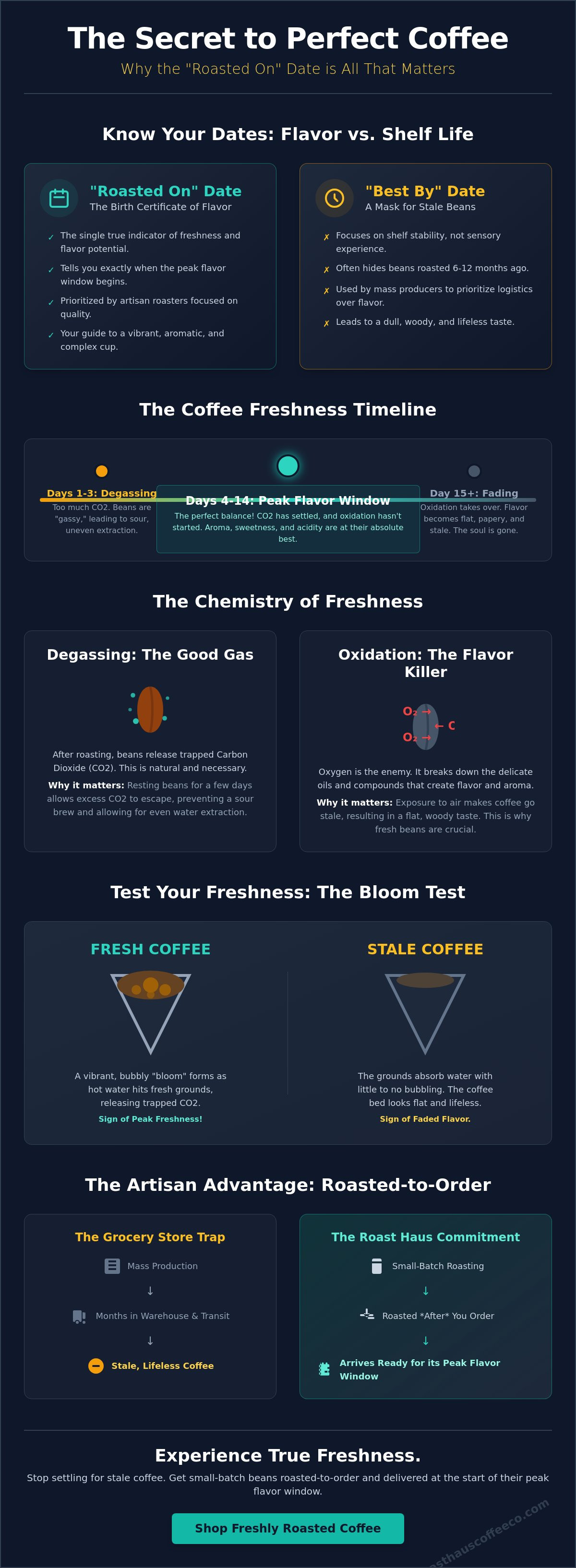
The "Roasted On" date is the specific day that raw, green coffee seeds were transformed through intense heat into the aromatic, brittle brown beans you recognize. While a "Best By" date focuses on shelf stability and safety, the roast date is the only true indicator of a coffee's chemical age and flavor potential. Understanding what does roasted on date mean for coffee is vital for anyone who values quality over convenience. Simply put, the "Roasted On" date is the birth certificate of your coffee's flavor. It tells you exactly when the clock started on the bean's peak window. Without this date, you are essentially brewing in the dark.
Why Big Brands Hide the Roast Date
Industrial coffee is built for the long haul. Large corporations prioritize logistics and mass distribution over sensory excellence, which is why they rarely show you a roast date. They need a product that can sit in a distribution center or on a grocery store shelf for months without raising alarms. By using "Best By" dates, they can easily mask beans that were roasted six to twelve months ago. This approach treats coffee like a canned good rather than a perishable artisanal product. This is what we call the "Grocery Store Trap." You pay for premium branding but receive a stale product that has lost its soul. The growing interest in Home roasting of coffee proves that more people are realizing that true freshness is the foundation of a great cup. In contrast, independent roasters prioritize transparency because we are proud of our timeline.
The Difference Between Freshness and Safety
It's a common mistake to think coffee goes "bad" in the same way milk or meat does. Coffee doesn't typically become unsafe to drink as it ages; it simply fades. Think of it like a loaf of sourdough or a fine wine. It has a specific window where the character is vibrant and the aroma is at its strongest. After that window closes, the coffee doesn't turn rancid or moldy under normal conditions. Instead, it becomes woody, papery, and flat. You lose the bright acidity of an Ethiopia Limu Organic or the rich, complex notes of a Kenya AA Supreme. High quality packaging with one way valves helps extend the life of the beans by keeping oxygen out, but it can't replace the value of a recent roast date. When you buy from a small batch roaster, you're choosing flavor integrity over industrial convenience. You aren't just buying a drink; you're buying the result of a carefully timed craft.
The Chemistry of Freshness: Degassing and Oxidation
Inside the roasting drum, heat triggers the Maillard reaction. This chemical dance between amino acids and reducing sugars creates the complex flavor profiles we crave. As the temperature rises, the cellular structure of the coffee seed breaks down, creating a significant buildup of carbon dioxide (CO2). When you ask what does roasted on date mean for coffee, you are really asking about the state of this internal pressure. The roast date tells you how much gas remains and how much flavor has been protected. Freshly roasted beans are essentially pressurized containers of gas and aromatic potential.
Degassing is the natural release of this trapped CO2. While some gas is necessary for a good brew, too much can be a problem. Conversely, oxidation is the primary enemy of quality. Once the beans leave the roaster, oxygen begins to break down the delicate oils and organic structures. Research on chemical changes during coffee storage shows that lipid oxidation is a major factor in flavor degradation over time. This is why the one-way valve on our bags is so critical. It allows the CO2 to escape safely while preventing oxygen from entering and stealing the bean's character.
Why You Shouldn't Brew Coffee the Second It's Roasted
Understanding what does roasted on date mean for coffee also means knowing when to wait. It's tempting to grind beans the moment they are cool, but a "gassy" cup often tastes metallic, salty, or overly sharp. The chemistry needs time to settle. If you brew too early, the escaping CO2 creates a physical barrier that prevents water from fully saturating the coffee grounds. This leads to uneven extraction and a thin, sour cup. Resting your beans for a few days allows the gas to dissipate enough for water to extract the true sweetness of the origin. For many of our selections, like the Ethiopia Limu Organic, a short resting period reveals a much more balanced and vibrant profile.
Aroma Loss: The First Thing to Go
Volatile organic compounds (VOCs) are the high-frequency notes of the coffee world. They are responsible for the complex scents of jasmine, citrus, or cocoa that define specialty coffee. These compounds are extremely fragile and begin to evaporate at room temperature. The connection between the dry aroma of the beans and the final brew is direct. If the beans don't smell complex, the cup won't taste complex. Industrial roasting often exposes beans to more oxygen during high-volume cooling and packaging. Our small-batch approach in Wyandotte limits this exposure. We focus on small-scale production to ensure these delicate VOCs make it from our roaster to your kitchen before they vanish.
The Freshness Timeline: When is Your Coffee at Its Peak?
Timing your first brew is a balance of chemistry and patience. While many people assume fresher is always better, coffee actually needs a resting period to reach its full potential. Most specialty coffees hit their peak between day 7 and day 21 after roasting. When you analyze what does roasted on date mean for coffee, think of it as a roadmap to the bean's flavor evolution. This timeline isn't fixed because the roast level significantly impacts how fast the beans degas. Dark roasts have a more porous structure and tend to peak faster, often within the first 5 to 7 days. Light roasts are denser and often need at least 10 days of rest to allow their complex acidity to settle into a balanced cup.
The brewing method you choose also dictates your target window. Espresso is particularly sensitive to carbon dioxide. If you pull a shot too early, the gas interferes with the water flow, leading to a thin, sour, and unpredictable crema. For espresso, we recommend waiting at least 10 to 14 days. Drip coffee and pour-overs are more forgiving and can be enjoyed much earlier in the cycle. Use the table below to track how your beans will likely taste as they age.
| Days Since Roast | Expected Flavor Profile |
|---|---|
| 1-3 Days | Sharp, metallic, or "gassy" notes; high acidity. |
| 4-7 Days | Vibrant and bright; flavors begin to clarify. |
| 7-14 Days | Peak sweetness; full body and integrated aromatics. |
| 15-21 Days | Mellow and smooth; subtle nuances are most apparent. |
| 22+ Days | Fading aromatics; flavors start to become muted or woody. |
The 1-7 Day Window: The Settling Phase
This early stage is ideal for pour-over enthusiasts who enjoy high, bright acidity. However, it can be a frustrating time for espresso users. The high volume of escaping CO2 makes it difficult to dial in your grinder. If you brew during this phase, pay close attention to the "bloom" in your dripper. You will see significant bubbling as the gas escapes. This is a sign of extreme freshness, but it requires a longer bloom time to ensure the water can actually reach the coffee particles for a proper extraction.
The 7-21 Day Window: The Sweet Spot
This is the target window for most home brewers. During these two weeks, the carbon dioxide has dissipated enough to allow for a clean, even extraction. This is when a bean like our Kenya AA Supreme shows its full complexity, revealing the deep fruit notes and heavy body that define the origin. The sweetness is at its highest point, and the aromatics are stable. If you want to experience the true intent of the roaster, this is the time to grind and brew.
21+ Days: The Gradual Decline
As you move past the three-week mark, you might notice the flavors becoming "muted." The bright sparks of citrus or berry begin to fade into a more generic coffee taste. This applies to all beans, including our Decaf Swiss Water Process selections. You can compensate for this age by grinding your beans slightly finer or increasing your coffee-to-water ratio. While the coffee is still perfectly safe to drink, the vibrant character that makes specialty coffee unique is slowly departing.
How to Test for Freshness and Store Your Beans
If you have a bag with a missing label or simply want to verify a roaster's claims, you don't have to guess about the quality of your brew. While understanding what does roasted on date mean for coffee gives you a theoretical baseline, physical tests provide the final word on integrity. Fresh coffee is active. It interacts with its environment in visible ways that stale coffee cannot replicate. By using a few simple methods at home, you can confirm if your beans are still in their peak flavor window or if they have begun the inevitable slide toward flatness.
The Bloom Test: A Step-by-Step Guide
The most reliable way to verify degassing is the bloom test. This is best performed with a pour-over dripper or a French press. Follow these steps to see the chemistry in action:
- Grind 20 grams of coffee and place them in your brewing device.
- Heat water to approximately 200 degrees Fahrenheit.
- Pour just enough water to saturate the grounds (about 40 grams).
- Wait 30 seconds and watch the surface.
In fresh coffee, the surface will swell, bubble, and "bloom" as carbon dioxide escapes. If the water simply sinks and the grounds remain flat and motionless, the coffee is likely past its prime. This lack of activity confirms that the VOCs and gases that carry flavor have already vanished.
The Best Way to Store Freshly Roasted Coffee
Once you open a bag, you must protect it from the "four horsemen" of staling: heat, light, air, and moisture. Your kitchen counter, especially near an oven or in direct sunlight, is the worst place for your beans. We recommend keeping your coffee in the original bag. Our bags include a one-way valve that allows CO2 to escape while blocking oxygen. If you must move them, use an opaque, airtight container. Avoid clear glass jars. While they look nice, light accelerates the breakdown of lipids and oils. Freezing is an option only if you use a vacuum sealer; otherwise, the frequent temperature changes and condensation will ruin the beans faster than the air will.
Identifying Stale Coffee Without a Date
Don't rely on the "oily" myth. Many people think oily beans are fresh, but surface oil is often a sign of an older dark roast or beans that have been exposed to heat. To check for freshness without a date, try the Ziploc bag test. Place a handful of beans in a small freezer bag, squeeze out all the air, and seal it. Leave it on the counter overnight. If the bag is puffed up with air the next morning, the beans are still degassing and are likely fresh. If the bag remains flat, the coffee is stale. If you find yourself with a bag of flat beans, don't throw them away. This is the perfect time to make cold brew, as the long immersion time can still extract sweetness from older coffee. To avoid the stale coffee trap entirely, you can browse our roasted-to-order collections to ensure you always start with a fresh date.
The Roast Haus Commitment: Why 'Roasted-to-Order' Wins
The "Roasted On" date is more than just a number on a bag. For us, it represents a specific promise of timing and quality. When you ask what does roasted on date mean for coffee at The Roast Haus, it means your beans were likely still green when you placed your order. We operate on a strict "Roasted-to-Order" philosophy. We don't start the roaster until your order is confirmed. This bespoke approach ensures that the "birth certificate" of your coffee's flavor is as recent as possible. It puts you in total control of the freshness timeline.
Our small-batch process in Wyandotte, Oklahoma, is designed to eliminate the long storage times that plague industrial coffee. We focus on integrity and transparency. Supporting an artisan coffee roaster is about knowing exactly who handled your beans and when they were finished. This direct connection between the roaster and the consumer is the only way to guarantee that you are receiving the full sensory potential of the crop. We treat every roast as a personal commitment to your morning routine.
From Our Roaster to Your Door in 24 Hours
Freshness is a race against the clock. We follow a 24-hour rule: we aim to ship your coffee within one day of roasting. This ensures that the essential "settling phase" happens while the beans are in transit. By the time your coffee subscription arrives, the beans are entering their peak flavor window. For those nearby, local pickup in Oklahoma offers the ultimate way to get your hands on fresh beans the moment they are cool. This model removes the uncertainty of warehouse storage and third-party logistics. It keeps the quality high and the process honest.
Taste the Difference of Small-Batch Craftsmanship
Mass-produced coffee is roasted for shelf life. Our beans are roasted for excellence. We include the roast date on every single bag of single-origin coffee because we have nothing to hide. This transparency is our hallmark as an independent, personal venture. When you understand what does roasted on date mean for coffee, you start to see why industrial "best by" labels are insufficient for a true enthusiast. You deserve a product that reflects the hard work of the farmers and the skill of the roaster. Experience true freshness and see the difference that a dedicated craftsman makes. Browse our roasted-to-order selections today and find your new favorite brew.
Master Your Coffee’s Peak Flavor Window
You now have the tools to transform your morning routine from a standard caffeine hit into a true sensory experience. Understanding what does roasted on date mean for coffee allows you to stop guessing and start brewing with confidence. Remember that the roast date is your guide to the peak flavor window. Aim for that 7 to 21 day sweet spot to experience the full complexity of your beans. Keep your coffee in its original valved bag and away from the heat of your kitchen counter to preserve those fragile aromatic compounds.
At The Roast Haus, we believe you shouldn't have to settle for stale grocery store beans. Our family-owned and operated team in Wyandotte, Oklahoma, is dedicated to small-batch artisan quality. We don't roast until you order. Then we ship within 24 hours to ensure the peak window starts in your kitchen. It's time to taste coffee as it was meant to be. Our commitment to integrity means you get the freshest possible product delivered straight to your door.
Shop our fresh, roasted-to-order coffee beans now and experience the difference that true craftsmanship makes in every cup. We look forward to being a part of your perfect brew.
Frequently Asked Questions
Is coffee still good 2 months after the roast date?
Yes, your coffee is perfectly safe to drink after two months, but it will have lost most of its vibrant character. By the 60-day mark, the delicate aromatics and bright acidity have significantly faded due to oxidation. You will likely notice a flat, woody, or papery taste. If you find yourself with beans this old, we recommend using them for cold brew, where the long immersion time can still extract some sweetness without highlighting the stale notes.
How long after the roast date is coffee at its best?
Coffee generally reaches its peak flavor between 7 and 21 days after the roast date. This window provides the perfect balance where the beans have released enough carbon dioxide to allow for clean extraction but still retain their volatile organic compounds. Different roasts vary slightly. A light roast like our Ethiopia Limu Organic often needs at least 10 days to settle, while darker roasts may hit their sweet spot closer to day 7.
Why is there a roast date instead of an expiration date?
A roast date is an indicator of quality and chemical age, while an expiration date is merely a measure of food safety. Since coffee is a shelf-stable product that doesn't spoil like milk, an expiration date tells you very little about how it will taste. Understanding what does roasted on date mean for coffee allows you to track the bean's flavor evolution. It gives you the transparency needed to ensure you are brewing during the peak window of sensory excellence.
Does coffee actually go bad or just lose flavor?
Coffee rarely goes bad in a way that poses a health risk, but it definitely loses its soul over time. It doesn't typically grow mold or become toxic if stored in a dry place. Instead, it undergoes a process of flavor degradation where the complex oils turn dull and the aroma vanishes. You aren't risking your safety by drinking old beans, but you are missing out on the unique notes of chocolate, fruit, or spice that define a fresh roast.
Can I drink coffee the same day it was roasted?
You can drink it, but the experience will likely be disappointing and unbalanced. Coffee roasted within the last 24 hours is saturated with carbon dioxide, which creates a physical barrier that prevents water from saturating the grounds. This often results in a cup that tastes metallic, salty, or unpleasantly sharp. We recommend waiting at least three to four days for drip coffee and up to two weeks for espresso to allow the chemistry to stabilize.
What is the coffee 'bloom' and why does it matter?
The bloom is the rapid bubbling and swelling that occurs when hot water first hits fresh coffee grounds. This reaction is the visual proof of degassing as carbon dioxide escapes the bean's structure. It matters because it signals that your coffee is fresh and active. A healthy bloom ensures the gas doesn't block water flow, leading to a much more even and flavorful extraction. If your coffee doesn't bloom, it's a sign that the beans are stale.
Does dark roast coffee stay fresh longer than light roast?
No, dark roast coffee actually tends to go stale faster than light roast coffee. The longer roasting process makes the cellular structure of the bean more porous and fragile. This allows internal oils to migrate to the surface more quickly, where they are immediately exposed to oxygen. Because light roasts are denser and have more intact cell walls, they protect their internal chemistry for a slightly longer period. Always check the date on your Honduras Morning Splendeur to ensure peak freshness.
Why do grocery store coffees only have a 'Best By' date?
Grocery store brands use "Best By" dates because their business model relies on long-term shelf stability and complex distribution chains. These dates often extend six to twelve months into the future, allowing them to sell beans that were roasted a long time ago. This helps them manage inventory but sacrifices the quality of your cup. Artisan roasters use a roast date because we prioritize transparency and want you to know exactly how fresh your small-batch beans really are.

